
Master Your Online Store’s Search Presence: An E-Commerce SEO Guide
Why Your Online Store Needs SEO to Thrive
E commerce website seo is the process of optimizing your online store so it ranks higher in search engine results, attracts more qualified visitors, and converts them into customers. Here’s what it involves:
- Keyword research to understand what your customers are searching for
- On-page optimization of product pages, category pages, and content
- Technical SEO to ensure your site is fast, mobile-friendly, and easy to crawl
- Link building to establish authority and trust
- User experience improvements that keep visitors engaged and buying
The e-commerce landscape is more competitive than ever. The global e-commerce market is projected to reach $8 trillion by 2027, which means thousands of online stores are fighting for the same customers you want to reach.
Here’s the reality: up to 99 percent of searchers stick to page one of Google. If your store isn’t there, you’re invisible to most potential customers.
Unlike paid advertising where you pay for every click, SEO drives organic traffic to your store without ongoing ad costs. When done right, it delivers sustainable growth, builds brand authority, and attracts customers who are actively looking for what you sell.
But e-commerce SEO isn’t the same as optimizing a blog or service website. You need to balance technical challenges like duplicate product pages, manage thousands of URLs, create unique content at scale, and compete in highly competitive niches.
This guide will walk you through everything you need to know to build a winning e-commerce SEO strategy—from foundational keyword research to advanced technical optimization.
The Unmissable Benefits of E-commerce SEO
Why dedicate time and resources to e commerce website seo? Because the benefits are profound and long-lasting, especially when compared to other marketing channels. We’re not just talking about getting more clicks; we’re talking about changing your online business.

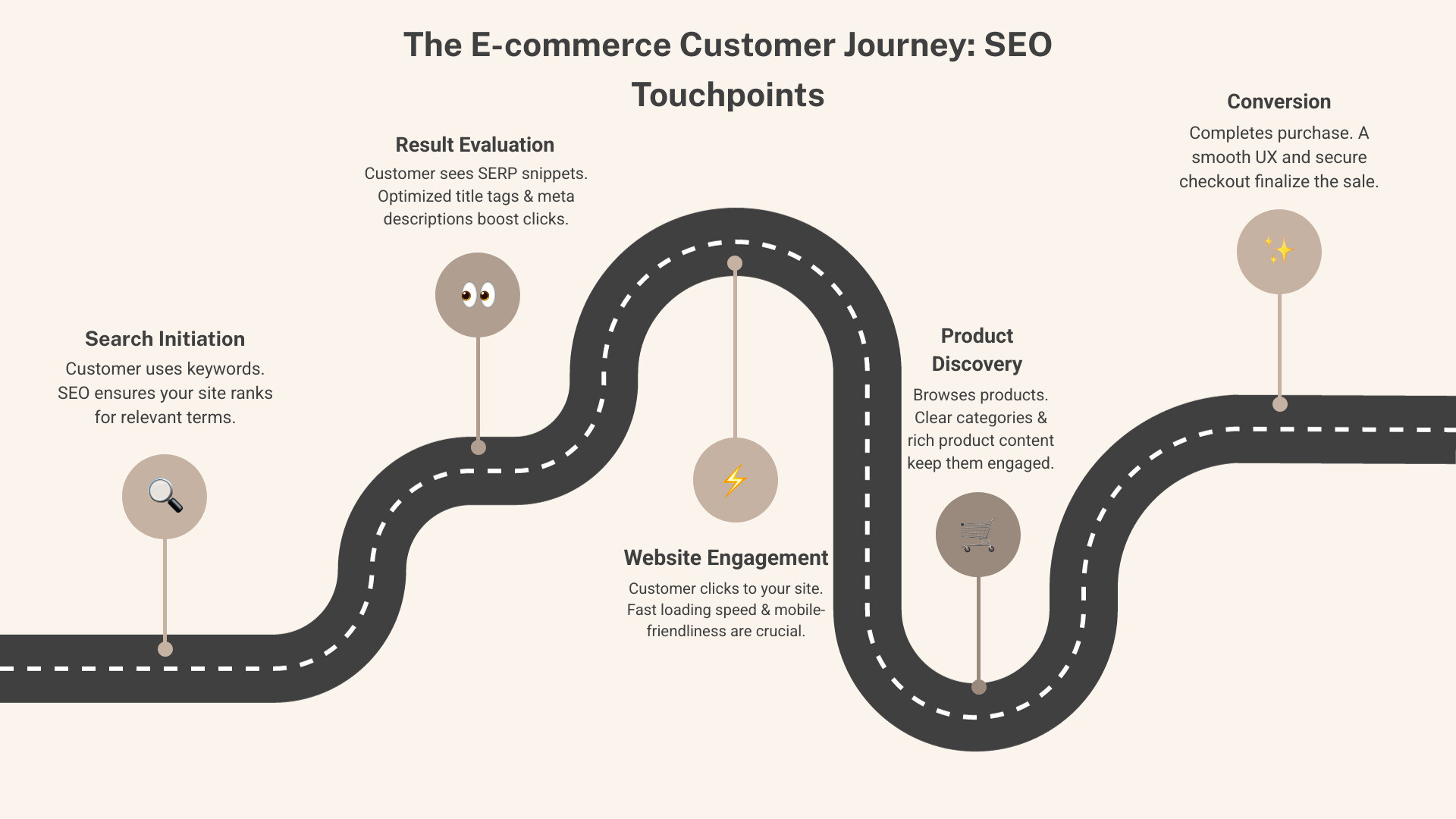
- Expanded Reach and Visibility: Our primary goal is to get your products in front of the right people. When your website ranks higher for relevant keywords, it naturally attracts visitors who are already interested in what you offer. This expanded reach means more eyes on your products and a greater chance for sales. 75% of people never look past page 1 of search results, so being visible there is non-negotiable.
- Higher Quality Traffic: Unlike casting a wide net with generic ads, SEO targets users with specific intent. When someone searches for “women’s running shoes size 8 Columbus OH,” they’re likely ready to buy. Optimizing for these specific, often long-tail, keywords ensures you attract visitors who are further down the purchase funnel, leading to a higher conversion rate.
- Improved User Experience: Search engines, especially Google, prioritize websites that offer a great user experience (UX). This means optimizing for speed, mobile-friendliness, and intuitive navigation. A seamless experience not only pleases search algorithms but also keeps your customers happy, encouraging them to browse longer and complete purchases.
- Cost-Efficiency and Sustainable Growth: SEO is a relatively low-cost channel to run efficiently, especially when compared to paid ads. While paid advertising requires you to pay for every click, optimizing your website draws in organic traffic for free. Once your SEO strategy is implemented, it continues to work for you, providing a steady stream of traffic and sales without constant expenditure. This translates to sustainable, long-term growth for your online store.
- Improved Brand Authority and Trust: When your site consistently ranks organically for search terms relevant to your products, it establishes your brand as an authority in your niche. This differentiation from competitors builds trust with potential customers, making them more likely to choose you over others.
E commerce website seo is an investment that pays dividends, driving not just traffic, but highly qualified traffic that converts, all while building your brand’s reputation and ensuring long-term success. If you’re looking to improve your online presence and sales, explore our SEO Services.
The Core Components of a Winning E-commerce SEO Strategy
A successful e commerce website seo strategy isn’t a one-and-done task; it’s a multi-faceted approach that requires continuous effort and adaptation. We focus on four interconnected pillars that form the foundation of any robust online store optimization plan: foundational keyword research, compelling content and on-page optimization, mastering technical SEO, and building authority through backlinks and PR.
These components work in synergy. For instance, high-quality content, which is the biggest ranking factor for SEO, needs a solid technical foundation to be discovered and a strong backlink profile to establish its authority. Let’s explore each.
Foundational Keyword Research: Understanding Your Customer’s Search
Keyword research is the bedrock of any successful SEO strategy. For an e-commerce site, it’s about understanding not just what people search for, but why they search for it. We aim to uncover the exact terms your potential customers use when looking for products like yours.
- Defining Buyer Personas and Search Intent: Before we even touch a keyword tool, we need to understand your ideal customer. Who are they? What problems are they trying to solve? Are they in the “information-gathering” phase (informational keywords like “how to choose a hiking backpack”) or ready to buy (transactional keywords like “buy waterproof hiking backpack Columbus OH”)? This distinction is crucial for targeting the right keywords and creating content that resonates. What is Search Intent?
- Transactional vs. Informational Keywords:
- Transactional keywords directly indicate a desire to purchase (“buy shoes online,” “best deals on laptops”). These are gold for product and category pages.
- Informational keywords relate to research or learning (“how to clean running shoes,” “reviews of ergonomic office chairs”). These are perfect for blog posts and guides that build brand authority and capture early-stage buyers.
- The Power of Long-Tail Keywords: While broad keywords might have high search volume, they often come with fierce competition. Long-tail keywords (e.g., “organic cotton baby clothes for sensitive skin”) are more specific, have lower search volume, but attract highly qualified traffic with a stronger intent to purchase. They often convert at a higher rate.
- Market Keyword Analysis: We analyze industry trends and customer needs specific to your niche and location (e.g., Columbus, Dublin, Ohio). This helps us identify untapped opportunities and understand local search patterns.
- Leveraging Keyword Research Tools: We use powerful tools to find and analyze keywords:
- Google Keyword Planner: An excellent starting point for finding new keywords, search estimates, and competitive insights. No budget for keyword research? No worries! You can use Google Search Console and Google Keyword Planner as your starting place.
- Google Search Console: Allows us to find “low-hanging fruit” keywords by identifying terms your site already ranks for, but could improve on. With Google Search Console, you can find low-hanging fruit keywords (terms that have low competition and high SEO value).
- Ubersuggest / Ahrefs: These tools provide in-depth analysis of keyword difficulty, search volume, and competitor rankings, helping us uncover valuable long-tail opportunities.
- Google Autocomplete & AnswerThePublic: These free resources reveal trending queries, locations, and common questions people ask, providing excellent inspiration for long-tail keywords and content ideas. To produce its results Google uses trending queries, locations, and freshness.
By carefully researching keywords, we ensure every piece of content and every page on your e-commerce site is optimized to attract the right customer at the right time.
Content and On-Page Optimization for E-commerce
Content is king, even for e-commerce. It’s not just about what you sell, but how you present it and the information you provide around it. Our focus here is on optimizing individual pages to rank well and convert visitors into buyers. This is where we implement our On-Page SEO Best Practices: Outrank Your Competitors.
- Unique Product Descriptions: Forget generic manufacturer descriptions. Google penalizes duplicate content. We craft compelling, keyword-rich product descriptions that highlight benefits, address customer pain points, and encourage purchase. Take inspiration from brands like Huel, which excels at detailing product benefits.
- High-Quality Product Images and Alt Text: Visuals are critical for e-commerce. We ensure your product images are high-resolution, clutter-free, and optimized for web speed. Crucially, we add descriptive alt text to every image. This not only helps visually impaired users but also gives search engines context about your images, improving your visibility in Google Images (a significant search engine itself!). Take this example from Tiffany&Co: As you can see, the background matches Tiffany & Co. brand coloring (Tiffany blue) and uses high-quality, clutter-free images. It also uses keywords in file names.
- Category Page Content: Don’t neglect your category pages! These are often high-ranking pages. We optimize them with unique introductory text, internal links to subcategories and key products, and relevant keywords to provide value to both users and search engines.
- Title Tags and Meta Descriptions: These are your storefront window in the search results. We craft compelling title tags (60-70 characters, including keywords and product names) and meta descriptions that entice users to click. Using terms like “buy online” in meta descriptions can increase organic CTR.
- Blog Content Strategy: Beyond product pages, a blog is essential for capturing informational searches and building authority. We develop blog content that addresses customer questions, offers buying guides, and compares products. For example, a blog post about “best hiking trails near Columbus Ohio” could link to relevant hiking gear products on your site. This not only drives traffic but also provides valuable internal links to your product pages. This aligns with our focus on Importance of Quality Website Content and our Content Marketing Services.
- Customer Reviews: User-generated content like reviews is invaluable. 90 percent of consumers consider reviews when making a buying decision. We help you encourage and leverage customer reviews, which provide social proof and fresh content for your product pages. Here’s an example from Nike’s website showing how it uses reviews:
By carefully optimizing your on-page elements, we ensure your e-commerce site speaks directly to both search engines and your potential customers.
Mastering Technical E-commerce Website SEO
Technical SEO for e-commerce is about ensuring your website is crawlable, indexable, and provides an excellent user experience from a structural standpoint. It’s the “complex code powering your search success” as we discuss in Technical SEO: The Complex Code Powering Your Search Success.
- Site Architecture and Navigation: A clear, logical site structure is paramount. We design an intuitive hierarchy (Homepage > Categories > Subcategories > Products) that makes it easy for both users and search engine crawlers to steer your site. Breadcrumbs are also essential for user orientation and SEO. Breadcrumbs are found in many web design tools, and you can add them using markup tags or JavaScript.
- URL Structure Best Practices: Simple, descriptive, and keyword-rich URLs are preferred. We aim for clean URLs that are easy to read and understand, avoiding stop words (like “the,” “and,” “of”) that can lower readability and potentially impact rankings. Google also has some advice on improving URL structure.
- Site Speed and Core Web Vitals: Speed is a critical ranking factor and a huge UX factor. Nearly 40% of people leave a site if it takes more than three seconds to load. We optimize images, minify code, and leverage caching to ensure your site loads quickly. Google’s Core Web Vitals measure page experience, and improving these metrics (Largest Contentful Paint, First Input Delay, Cumulative Layout Shift) is crucial. You can test your site’s speed with tools like GTmetrix or Google’s PageSpeed Insights. For more on this, see Core Web Vitals: Why Google’s New Update May Lower Your Website’s Ranking.
- Mobile-First Design: With the majority of searches now happening on mobile devices, Google primarily uses the mobile version of your site for indexing and ranking. We ensure your e-commerce site is fully responsive and optimized for mobile users. Learn more about What is Mobile-First Indexing?.
- Structured Data (Schema Markup): This is code that helps search engines understand the context of your content. For e-commerce, we implement schema markup for products, reviews, prices, and availability. This enables rich snippets in search results (e.g., star ratings, price directly under the listing), making your products stand out and increasing click-through rates. See examples of review snippets.
- Canonical Tags for Duplicate Content: E-commerce sites often have duplicate or near-duplicate content (e.g., products available in different colors or sizes, or filter pages). We use canonical tags to tell search engines which version of a page is the “master” version, preventing SEO penalties and ensuring ranking signals are consolidated. [Learn more about canonical tags](https://moz.com/learn/seo/canonicalization#:~:text=A%20canonical%20tag%20(aka%20%22rel,content%20appearing%20on%20multiple%20URLs.).
- XML Sitemaps and SSL Certificates: An XML sitemap helps search engines find all important pages on your site. We ensure your sitemap is up-to-date and submitted to Google Search Console. Additionally, an SSL certificate (HTTPS) is non-negotiable for e-commerce, encrypting data and building customer trust. While John Mueller says it’s a lightweight ranking factor, it’s essential for security and user confidence.
By carefully handling these technical aspects, we build a robust foundation for your Website Designing SEO Company and ensure your online store is fully optimized for search engine discovery and user satisfaction.
Building Authority with Backlinks and PR
Even with perfect on-page and technical SEO, your site needs authority to rank for competitive terms. This is where backlinks and digital PR come in. Backlinks are links from other reputable websites to yours, acting as “votes of confidence” for search engines.
- The Role of Backlinks: High-quality backlinks signal to search engines that your site is a trusted and authoritative source of information. This significantly boosts your domain authority and, consequently, your search rankings.
- Quality Over Quantity: Not all backlinks are created equal. A few links from highly authoritative, relevant websites (like .edu or .gov domains, or established industry publications) are far more valuable than many low-quality, spammy links. We focus on earning relevant, high-quality links.
- Digital PR Outreach: This involves strategically reaching out to journalists, bloggers, and influencers to earn mentions and links. Services like HARO (Help a Reporter Out) connect journalists with expert sources, offering excellent opportunities for exposure and backlinks.
- Guest Blogging: Writing high-quality guest posts for other reputable websites in your niche can earn you valuable backlinks and drive referral traffic. We focus on creating unique, insightful content that provides value to the host site’s audience.
- Internal Linking Strategy: While external backlinks are crucial, don’t underestimate the power of internal links. A well-structured internal linking strategy guides users and search engines through your site, distributing “link juice” and highlighting important pages.
- Avoiding Paid Links: Buying links that violate Google’s guidelines can lead to severe penalties. We adhere to ethical, white-hat SEO practices to build sustainable authority for your brand.
Our comprehensive Digital Marketing Services include strategic link building and PR to lift your online store’s authority and visibility.
B2B vs. B2C: Tailoring Your E-commerce SEO Approach
While the core principles of e commerce website seo remain consistent, the specific strategies we employ differ significantly between B2B (business-to-business) and B2C (business-to-consumer) e-commerce. Understanding these nuances is key to optimizing for the right audience and sales cycle.
| Feature | B2B E-commerce SEO | B2C E-commerce SEO |
|---|---|---|
| Target Audience | Formal business representatives, procurement managers, decision-makers. | Individual consumers, often making impulse or emotional purchases. |
| Buying Cycle | Longer, complex, involves multiple stakeholders, extensive research, and often multiple touchpoints. | Shorter, more direct, often driven by immediate needs or desires. |
| Keyword Intent | Informational (“best industrial cleaning supplies”), problem-solving (“CRM software for small businesses”), comparison (“ERP system A vs. ERP system B”), solution-oriented. | Transactional (“buy running shoes online”), brand-specific (“Nike Air Force 1 deals”), feature-focused (“noise-cancelling headphones”). |
| Content Goals | Educate, inform, build trust, establish expertise, provide detailed specifications, case studies, whitepapers. | Inspire, entertain, trigger immediate purchase, showcase product lifestyle, reviews, visual content. |
| Primary KPIs | Lead generation (inquiries, demo requests), qualified traffic, time on site, returning visitors, customer lifetime value. | Organic traffic, conversion rate, average order value, bounce rate, direct sales, social shares. |
For B2B e-commerce, our strategy leans heavily into educational content, focusing on solving complex problems for businesses. This often means longer blog posts, detailed product specifications, and case studies that address the concerns of multiple decision-makers. The buying cycle is longer, so nurturing leads with valuable information is paramount. We help businesses with their Digital Marketing for B2B Services.
Conversely, B2C e-commerce focuses on capturing immediate interest and driving direct sales. This involves highly optimized product pages with compelling visuals, strong calls to action, and leveraging customer reviews. Content might be more visually driven, with short, engaging descriptions designed to trigger a purchase. Our work for B2C clients, as seen in Our Work: B2C, emphasizes direct engagement. Similarly, our Our Work: B2B showcases our custom approaches.
Understanding these differences allows us to create a highly effective e commerce website seo strategy that aligns with your specific business model and customer journey.
Measuring and Refining Your E-commerce Website SEO Performance
Implementing an e commerce website seo strategy is only half the battle; the other half is continuously monitoring, analyzing, and refining it. We use data to understand what’s working, identify areas for improvement, and ensure your efforts translate into tangible business growth.
Common Challenges and How We Overcome Them
E-commerce SEO comes with its unique set of problems. We’ve seen them all and have strategies to tackle them:
- Duplicate Content: This is a major issue for e-commerce sites, often arising from product variations (colors, sizes), filter pages, or manufacturer descriptions. We use canonical tags, optimize product variants, and create unique content for each page to prevent search engine penalties.
- Technical Glitches: Broken links, slow loading times, indexing errors, or improper redirects can severely hinder your SEO. We conduct regular technical audits using tools like ScreamingFrog to identify and fix these issues proactively.
- Thin Content: Many product pages have minimal content, offering little value to users or search engines. We enrich these pages with unique descriptions, FAQs, and user-generated content to make them more robust.
- Keyword Cannibalization: When multiple pages on your site target the same keywords, they can compete against each other, diluting your SEO efforts. We analyze keyword usage across your site and consolidate or differentiate content to ensure each page targets unique keywords.
If you’re asking “Why is My SEO Not Working?” we can help diagnose and resolve these common challenges.
Using Analytics to Inform and Measure Success
Our approach is data-driven. We rely on powerful analytics tools to track performance and make informed decisions:
- Google Search Console: This indispensable tool provides direct insights from Google about your site’s performance in search. We use it to monitor indexing status, identify crawl errors, track search queries, and measure click-through rates. Search Console DocumentationSearch Console is our go-to resource.
- Google Analytics: We connect Google Analytics to your e-commerce store to track user behavior, traffic sources, conversion paths, and much more. This helps us understand your customers, optimize your store, and improve marketing ROI.
Key Performance Indicators (KPIs) to Track
To truly measure e commerce website seo success, we focus on KPIs that directly impact your bottom line:
- Organic Traffic: The number of visitors coming to your site from unpaid search results. A steady increase indicates improving visibility.
- Conversion Rate: The percentage of organic visitors who complete a desired action, such as making a purchase. This is the ultimate measure of SEO effectiveness for e-commerce.
- Keyword Rankings: Your position in search results for target keywords. We monitor these to see if our optimization efforts are paying off.
- Bounce Rate: The percentage of visitors who leave your site after viewing only one page. A high bounce rate on key pages can indicate UX issues.
- Average Order Value (AOV): The average amount spent per order. While not directly an SEO metric, a higher AOV from organic traffic indicates that SEO is attracting more valuable customers.
By continuously analyzing these metrics and adapting our strategies, we ensure your e commerce website seo efforts are optimized for maximum impact and sustained growth. This iterative process is a core part of our Digital Marketing Optimization services.
Frequently Asked Questions about E-commerce SEO
What are the first steps for launching a new e-commerce website from an SEO perspective?
Pre-launch SEO is critical for a strong start. Your initial focus should be on thorough keyword research to understand your market, planning a logical site structure that’s easy for users and search engines to steer, and ensuring all technical SEO basics are in place before you go live. Following a pre-launch preparation checklist can prevent major issues down the line.
How long does it take to see results from e-commerce SEO?
SEO is a long-term strategy, not an overnight fix. While some minor improvements can be seen quickly, significant results like ranking on the first page for competitive keywords typically take 4 to 12 months. The exact timeline depends on factors like your industry’s competitiveness, your website’s history, and the consistency of your SEO efforts. Learn more about how long it takes to get results.
How will AI affect e-commerce SEO?
AI is already changing SEO, particularly with Google’s Search Generative Experience (SGE). For e-commerce, this means a greater emphasis on creating high-quality, helpful content that directly answers user questions. AI will also power more sophisticated personalization in search results and create new opportunities for optimizing product listings for conversational queries. Understanding how AI will affect SEO is key to future-proofing your strategy.
Conclusion: Build Your E-commerce Empire on a Strong SEO Foundation
In today’s dynamic digital marketplace, a robust e commerce website seo strategy isn’t just an advantage—it’s a necessity. We’ve explored the key pillars: from understanding your customer through foundational keyword research and crafting compelling, optimized content, to mastering the technical intricacies of your site and building undeniable authority through backlinks and PR. We’ve also highlighted the distinctions between B2B and B2C approaches and how crucial it is to measure and refine your efforts continuously.
SEO is an ongoing investment, but one that delivers significant long-term value. It’s about securing your online presence, attracting highly qualified customers, and fostering sustainable growth that outlasts fleeting ad campaigns.
At ForeFront Web, we specialize in building data-driven strategies to help businesses like yours in Columbus, Dublin, and throughout Ohio achieve sustainable growth. We believe in transparency, in-house expertise, and delivering measurable results that help you dominate the search results for your online store.
I’m Nick Aiello, with over 15 years of marketing experience, and our team has helped countless businesses master e commerce website seo to drive sustainable growth and outperform their competitors.
Ready to transform your online store’s search presence and open up its full potential? Take the next step with us today.