
Beginner’s Guide to Paid Search Marketing
Why Paid Search Marketing is Essential for Business Growth
Paid search marketing is a digital advertising strategy where businesses pay to display their ads in search engine results pages (SERPs) when users search for specific keywords. Unlike organic search results, paid search ads appear at the top of the page and are marked with “Ad” labels, giving businesses immediate visibility for their target audience.
Here’s how paid search marketing works:
- Pay-per-click model: You only pay when someone clicks on your ad
- Keyword bidding: You bid on relevant search terms your customers use
- Instant visibility: Your ads can appear on the first page immediately after campaign launch
- Targeted reach: Show ads to specific demographics, locations, and devices
- Measurable results: Track clicks, conversions, and return on investment in real-time
The numbers speak for themselves. Over 90% of online experiences begin with a search engine, and businesses make an average of $2 for every $1 they spend on Google Ads. With 85% of consumers using search engines to find products or services, paid search puts your business directly in front of high-intent customers at the exact moment they’re ready to buy.
The key benefits include:
- Immediate results – Unlike SEO, which takes months to show results
- Budget control – Set daily limits and adjust spending based on performance
- Precise targeting – Reach customers by location, device, time of day
- Competitive advantage – Appear above competitors in search results
- Data insights – Learn what messaging and keywords convert best
I’m Nick Aiello, and I have over 15 years of experience helping businesses succeed with paid search marketing strategies. Throughout my career, I’ve seen how paid search marketing can transform a business’s online presence and drive immediate, measurable results.
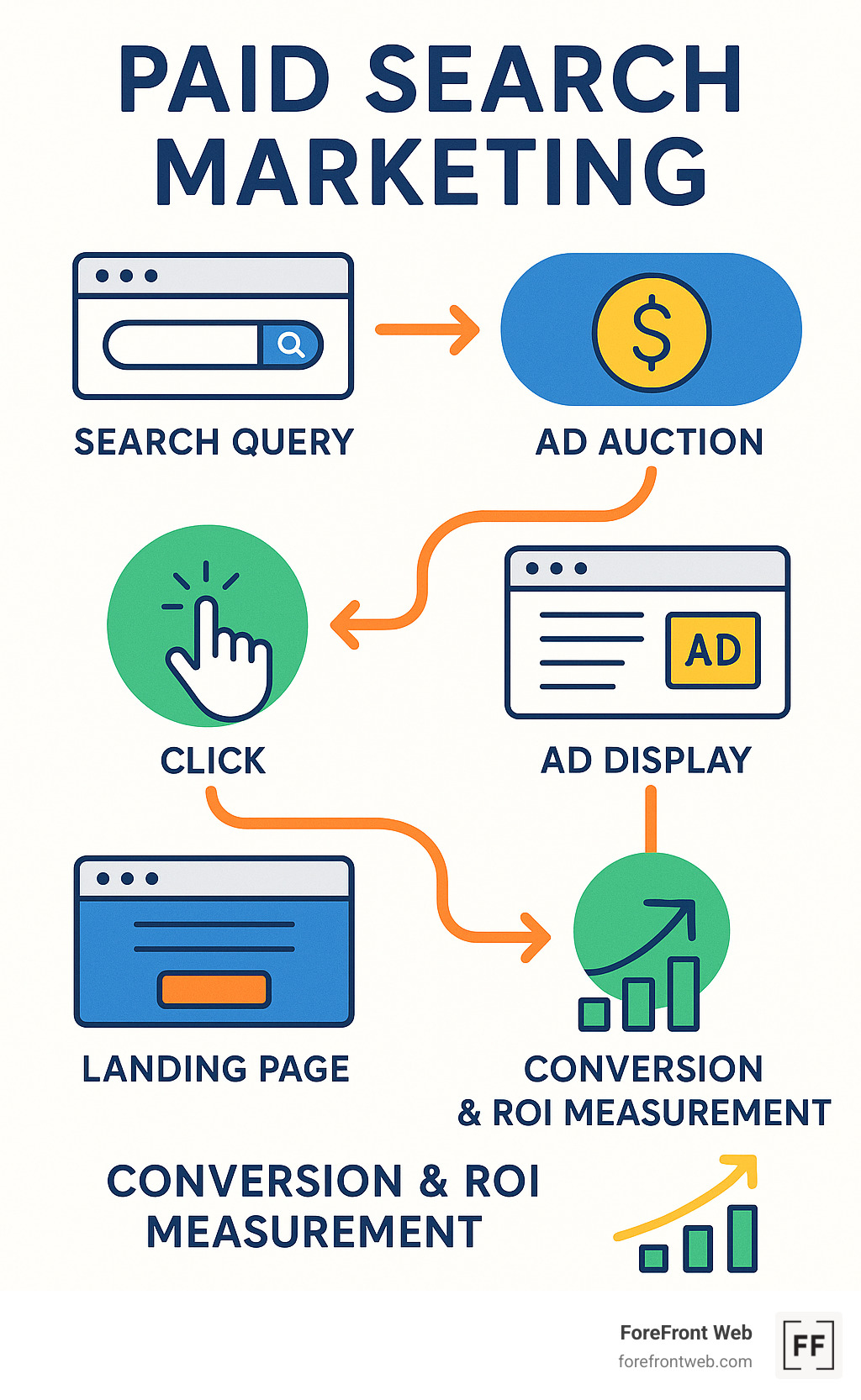
Quick look at paid search marketing:
What is Paid Search and How Does the Ad Auction Work?
Think of paid search marketing as a lightning-fast auction that happens millions of times every day. Every time someone types a query into Google, an instant auction takes place behind the scenes to decide which ads appear and in what order. It’s like a high-speed bidding war, except it’s over in milliseconds.
This is the foundation of the pay-per-click (PPC) model that powers Search Engine Marketing (SEM). You’re essentially renting prime real estate at the top of search results, but you only pay when someone actually clicks on your ad. No clicks, no cost.
Here’s where it gets interesting: the highest bidder doesn’t always win. Google’s ad auction is smarter than that. It considers not just how much you’re willing to pay, but how good your ad is for users. This levels the playing field and rewards businesses that create genuinely helpful, relevant ads.
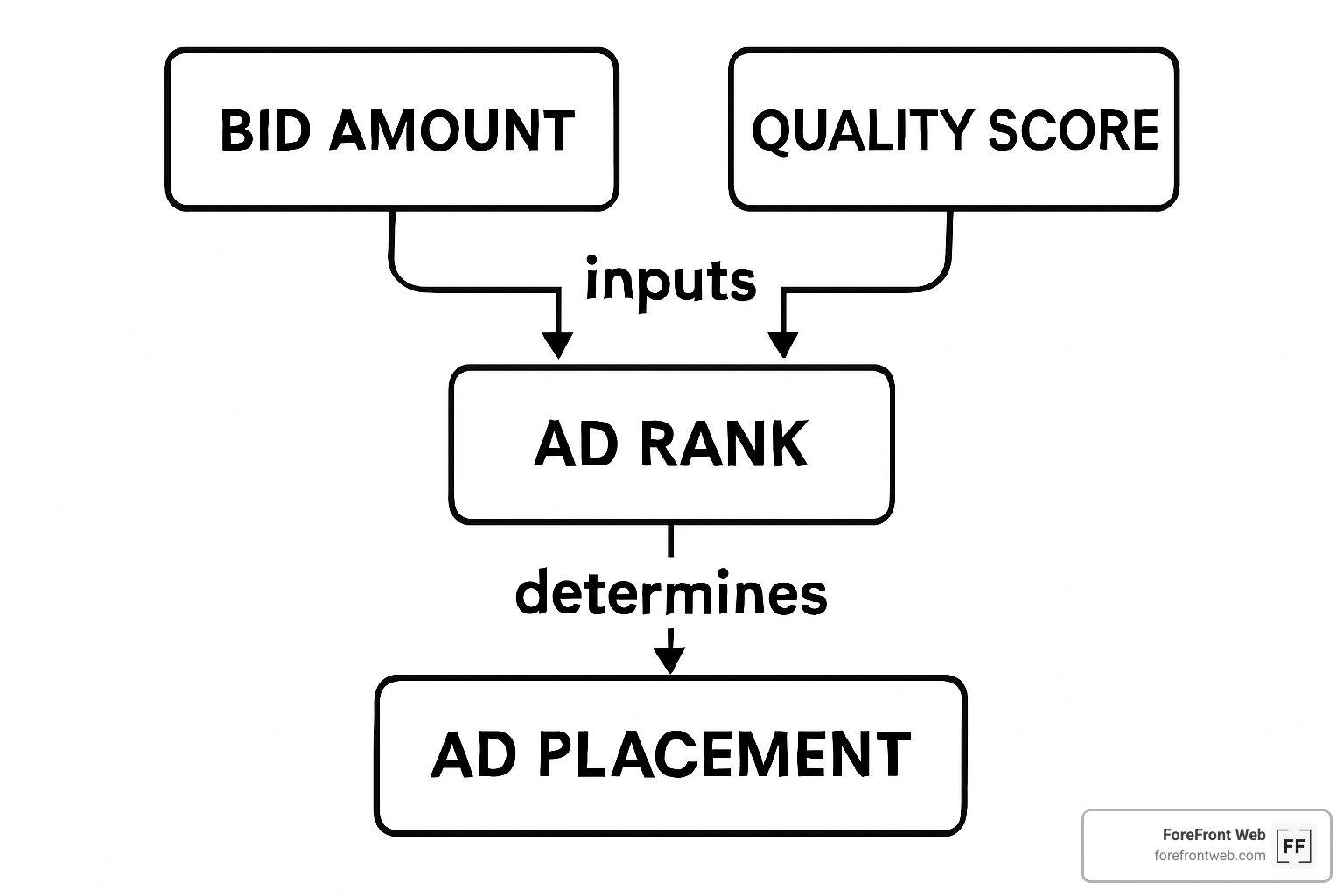
The auction happens through a complex calculation called Ad Rank. Think of it as your overall score in the auction. It’s determined by multiplying your maximum bid by your Quality Score. So if you bid $2 and have a Quality Score of 8, your Ad Rank is 16. The ads with the highest Ad Rank scores win the top positions.
Quality Score is Google’s way of measuring how relevant and useful your ad is to searchers. It’s scored from 1 to 10, and it’s incredibly important because it directly affects both your ad position and your Cost-Per-Click (CPC). A higher Quality Score means you pay less for better positions.
The beautiful thing about this system is that you often pay less than your maximum bid. If you bid $3 but the next highest Ad Rank only requires $2.50 to beat, you might only pay $2.51. It’s like winning an auction for less than you were willing to spend.
The Core Components of Ad Rank
Understanding Ad Rank is a value that determines ad placement is like having the secret recipe for search success. Google looks at several key ingredients when calculating your Ad Rank.
Keyword relevance is perhaps the most straightforward factor. If someone searches for “emergency dentist Columbus” and your ad targets “Columbus emergency dental services,” that’s a perfect match. Google rewards this tight connection between search intent and your keywords.
Expected Click-Through Rate (CTR) is Google’s prediction of how likely people are to click your ad. This is based on historical performance of similar ads and keywords. If your ads consistently get clicked, Google assumes future searchers will find them appealing too.
Landing page experience measures what happens after someone clicks your ad. Does your landing page load quickly? Is it mobile-friendly? Does it actually deliver what your ad promised? Google tracks these signals because they want users to have a great experience from search to final destination.
Maximum bid is simply the most you’re willing to pay for a click. While it’s important, it’s just one piece of the puzzle. A well-crafted ad with a modest bid can easily outrank a poorly optimized ad with a sky-high bid.
The system rewards quality over pure spending power, which is why learning how to improve your Quality Score is crucial for long-term success and lower costs.
Types of Paid Search Ads
Paid search marketing offers several ad formats, each designed for different business goals and customer behaviors.
Search ads are the classic text-based ads that appear above organic results. These are perfect for capturing high-intent users who know exactly what they want. When someone searches “buy winter boots online,” they’re ready to make a purchase.
Shopping ads transform the search experience for e-commerce businesses. Instead of just text, users see product images, prices, and store information right in the search results. These visual ads often get higher click-through rates because shoppers can see exactly what they’re getting.
Display ads take your message beyond search results to websites, apps, and videos across the internet. The Google Display Network reaches over 90% of internet users, making it incredibly powerful for building brand awareness and reaching people earlier in their buying journey.
Local service ads are a game-changer for service-based businesses like plumbers, electricians, and lawyers. These ads appear at the very top of local search results and operate on a cost-per-lead basis rather than cost-per-click. You only pay when someone actually contacts you.
Retargeting ads help you reconnect with people who visited your website but didn’t convert. These ads follow users across the web, gently reminding them about your products or services. It’s like having a friendly salesperson who never gives up.
Each ad type serves a specific role in guiding customers from initial awareness to final purchase. The key is matching the right ad format to your business goals and where your customers are in their buying journey.
Paid Search vs. SEO: A Powerful Combination
“Many business owners ask me whether they should focus on paid search marketing or SEO. After over 15 years in marketing, I’ve learned that this question misses the point entirely. The real magic happens when you use both strategies together.”
-Nick Aiello, over 15 years of marketing experience
Think of it this way: paid search is like renting a prime storefront location, while SEO is like buying property in that same area. Both have their place in a smart business strategy.
| Factor | Paid Search | SEO |
|---|---|---|
| Speed | Immediate results | 3-6 months for results |
| Cost | Pay per click | Time and content investment |
| SERP Placement | Top of page, marked “Ad” | Below paid ads |
| Longevity | Stops when budget ends | Long-term traffic |
| Targeting | Precise demographic targeting | Broad keyword targeting |
| Testing | Easy A/B testing | Harder to test changes |
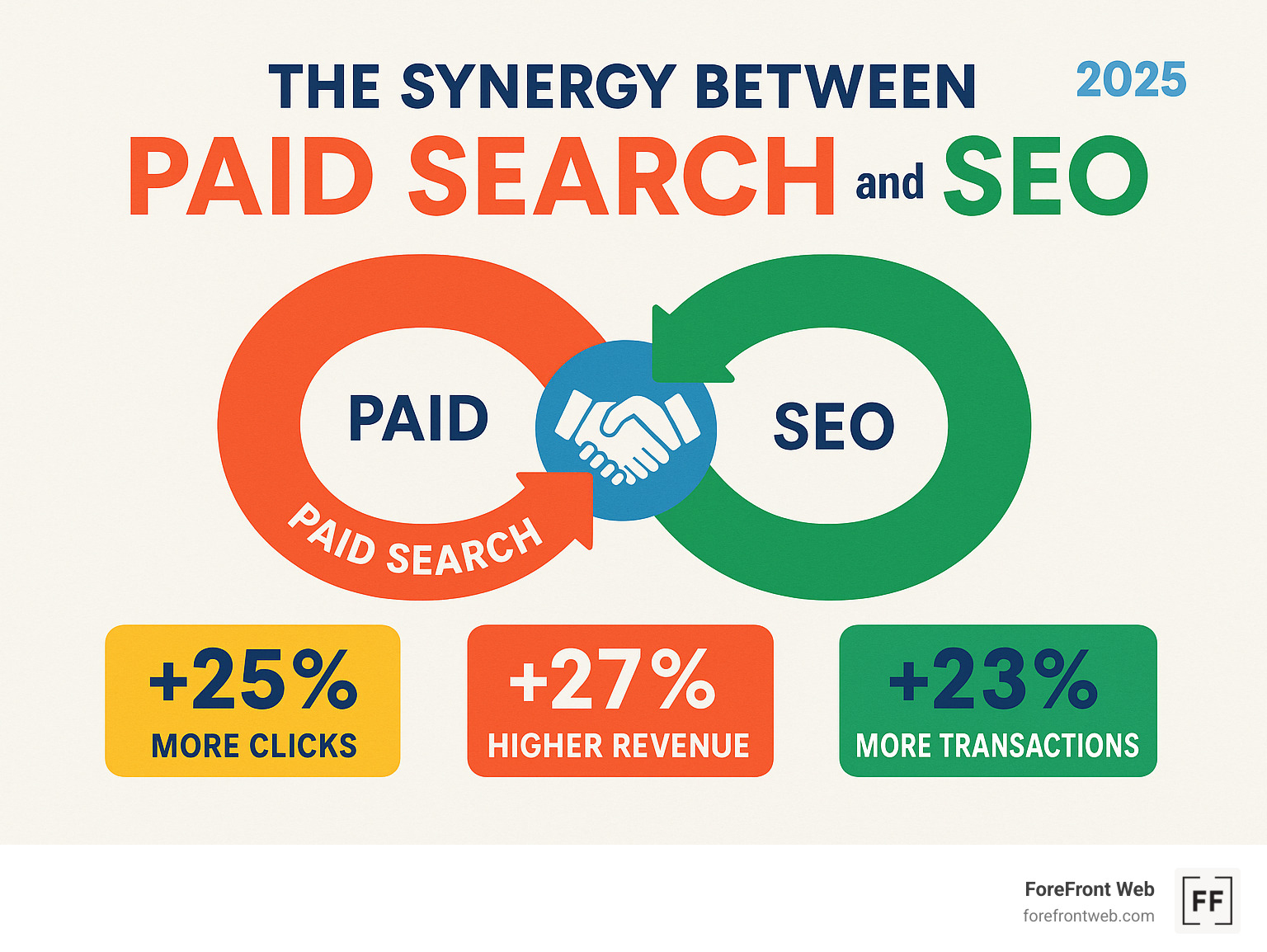
The real power comes from SERP domination. When your business appears in both paid and organic results for the same search, you capture more clicks and build incredible brand credibility. Users see you everywhere, which builds trust faster than appearing in just one spot.
Paid search provides valuable keyword data that makes your SEO strategy smarter. You can quickly identify which keywords convert best in paid campaigns, then optimize your organic content around those proven winners. It’s like having a crystal ball for your SEO efforts.
Testing messaging becomes incredibly easy with paid search. You can test different headlines, descriptions, and calls-to-action in real-time, then apply the winning messages to your organic content. This saves months of guesswork in your SEO strategy.
For your long-term strategy, SEO builds sustainable traffic that doesn’t require ongoing ad spend. It’s the gift that keeps giving. For short-term results, paid search delivers immediate visibility and traffic while your SEO efforts gain momentum.
As we explain in our FAQ: Is Organic SEO Better Than Paid Search?, neither approach is inherently better – they serve different purposes and timelines. The smartest businesses use both.
Here’s something interesting: paid ads don’t directly increase organic traffic but can indirectly trigger it by increasing brand awareness and encouraging more branded searches. When people see your ads, they’re more likely to search for your brand name later, boosting your organic traffic.
The bottom line? Paid search marketing and SEO aren’t competitors – they’re teammates working toward the same goal of getting your business found online.
Key Benefits of a Paid Search Strategy
Think of paid search marketing as a fast pass to customers who are already looking for you. Unlike channels that take months to mature, PPC campaigns can start generating leads the same day they launch.
Why Paid Search Works
- Immediate visibility – appear at the top of Google within hours.
- Precise targeting – reach people by city, device, schedule or even household income.
- Budget flexibility – raise, lower or pause spending any time.
- Measurable ROI – track every click, call and sale in real time.
- Brand authority – repeated top-of-page exposure builds trust.
- High-intent leads – ads show only when someone is actively searching for your solution.
Google estimates that businesses earn about $2 for every $1 invested in Google Ads. Couple that with detailed analytics and it becomes clear why PPC is often the quickest path to profitable growth.
Need help sizing your investment? Our FAQ on campaign budgets walks through a simple, numbers-first process.
How to Set Up Your First Paid Search Marketing Campaign
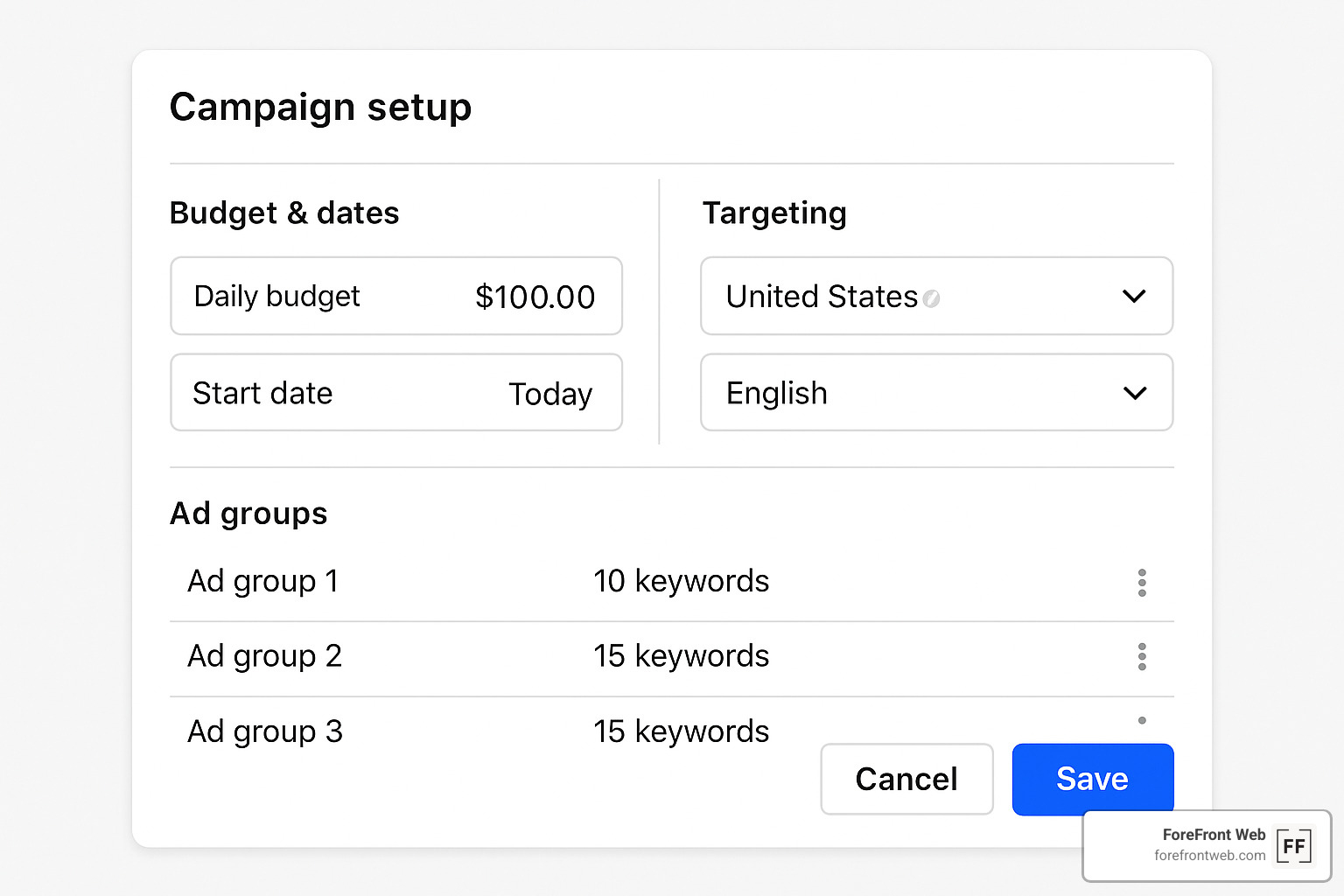
I’m Julie Camp, with over 20 years of marketing experience, and I promise—your first campaign doesn’t have to be complicated. Stick to the fundamentals below and you’ll avoid 90 % of beginner mistakes.
1. Define Your Goal & Budget
What counts as success? A contact form, a phone call, an online sale? Pick one primary action and set a daily budget you’re comfortable testing for 30 days. You can always scale up once you see positive returns.
2. Organize Keywords Into Tight Ad Groups
Group closely related keywords—like “wedding cakes,” “birthday cakes,” and “cupcakes”—so each ad can speak directly to the searcher’s intent. Use Google’s Keyword Planner to uncover volume and competition, and add negative keywords (e.g., “free,” “jobs”) to block irrelevant clicks.
3. Write Simple, Relevant Ads
Include the main keyword in the headline, state your differentiator, and end with a clear call-to-action such as “Get a Free Quote” or “Call 24/7.” Relevance boosts Quality Score, which in turn lowers cost-per-click.
4. Build a Matching Landing Page
Deliver exactly what the ad promises, load fast, and make the next step obvious—usually a short form or click-to-call button. Mobile-friendliness is non-negotiable; over half of all ad clicks come from phones.
5. Track, Test, Tweak
Install conversion tracking before you launch. Check campaigns daily the first week, then weekly. Kill keywords that spend without converting, raise bids on winners, and A/B test headlines or images one change at a time.
For a deeper walkthrough, see our guide on managing Google Ads for clients.
Best Practices for Optimizing Paid Search Campaigns
Running ads is just the start—the real gains come from ongoing tuning.
Ad extensions (sitelinks, calls, locations) make your ads larger and more useful, often boosting CTR by double-digit percentages. Google confirms extensions can improve visibility.
Bid strategies should match goals. Start with manual CPC to learn your numbers, then test automated options like Target CPA once you have reliable conversion data.
Audience segmentation lets you craft messages for new visitors, past buyers, or high-value zip codes instead of treating everyone the same.
Conversion Rate Optimization (CRO) on the landing page can cut cost-per-acquisition faster than lowering bids. Test shorter forms, clearer headlines, or stronger trust signals.
Finally, review reports for patterns: best-performing keywords, profitable times of day, or devices that convert cheaper. Small data-driven tweaks compound into big savings.
Need an expert eye? Our in-house team offers turnkey PPC Management Services.
Frequently Asked Questions about Paid Search Marketing
What is the difference between paid search and SEM?
SEM (Search Engine Marketing) is the umbrella term that covers both paid ads and SEO. Paid search is the paid slice of that pie—you pay each time someone clicks your listing.
How much should a small business spend?
Budgets vary by industry, but most local companies start between $500–$2,000 per month. Focus on cost-per-acquisition rather than total spend; if every $1 brings back $3 in revenue, scale with confidence. More tips in our guide on digital marketing budgets.
Can anyone guarantee the #1 spot?
No. Google runs a fresh auction for every single search. With strong Quality Scores and smart bids you can win many top placements, but a permanent #1 is impossible to promise.
How quickly will I see results?
Ads can appear within hours. Expect 2–4 weeks to gather enough data for meaningful optimisations, and 2–3 months for a well-tuned, stable campaign.
What’s a “good” click-through rate?
On search ads, 3–5 % is a solid benchmark. Display and Shopping ads run lower. Conversions and profit matter more than raw CTR.
Should I pause SEO while running ads?
Definitely not. SEO builds long-term traffic; paid search delivers instant visibility. Running both means you dominate more real estate on the results page and capture more total clicks.
Have another question? Reach out—our in-house team in Dublin, Ohio is happy to help.
Conclusion: Is Paid Search Right for You?
After 35 years in marketing, I can confidently say that paid search marketing is one of the most powerful tools available to businesses today. But like any tool, its effectiveness depends on how you use it.
The real question isn’t whether paid search works – the data clearly shows it does. The question is whether you’re ready to commit to doing it right.
Strategic planning forms the foundation of every successful campaign. You can’t just pick a few keywords, write some ads, and hope for the best. The businesses that succeed with paid search marketing are those that take time to understand their customers, research their market, and develop a comprehensive strategy that aligns with their business goals.
Continuous optimization separates the winners from the losers. I’ve seen too many businesses launch campaigns with great enthusiasm, only to abandon them after a few weeks because they didn’t see immediate perfection. The truth is, paid search is like learning to play an instrument – you get better with practice, patience, and persistence.
Driving targeted traffic is where paid search truly shines. Unlike traditional advertising where you’re interrupting people, paid search marketing puts you in front of customers who are actively looking for what you offer. These aren’t random visitors – they’re people who typed your solution into a search engine.
Achieving business goals through paid search requires realistic expectations and professional execution. While you can start seeing traffic within hours, building profitable, scalable campaigns takes time, expertise, and ongoing attention to detail.
At ForeFront Web, we’ve helped businesses across Columbus, Dublin, and throughout Ohio transform their online presence through strategic paid search marketing. Our in-house expertise means you get proven, high-conversion strategies without the risks and communication gaps that come with outsourcing.
Whether you’re a local plumber competing against national chains or a growing e-commerce business looking to scale, paid search can level the playing field. The beauty of the system is that it rewards relevance and quality, not just big budgets.
Ready to explore what paid search marketing can do for your business? Explore our expert Paid Search Services and find how we can help you achieve your growth goals through strategic, data-driven campaigns.
Every successful journey starts with a single step. The question isn’t whether paid search can work for your business – it’s whether you’re ready to take that step toward growth.